Habit support that learns from real life.
Choose one habit. Make a plan you can really do. MotiveHabit learns from what happens next and changes the support as your pattern becomes clearer.
You
A living picture of what helps you follow through — built from what you actually do.
How you tend to change
Six parts of how you build habits that MotiveHabit has learned from your check-ins.
Mornings work best
Progress works best
Direct is working
Low energy shows up most
Smaller restarts work best
Mornings keep showing up
Start with one habit. Learn from the days you actually live.
MotiveHabit keeps the loop simple: make a plan, get support when it helps, record what really happened, then use that evidence to make the next plan more realistic.
Choose one focus
Give one habit your attention so the learning stays clear.
Make a real plan
Pick a time and size that fit the life you have now.
Get useful support
Nudges can change with the day instead of repeating the same reminder.
Log what happened
Done, partly done, skipped, duration, amount or lapse all count as useful information.
Let the plan improve
Your real pattern helps shape what MotiveHabit suggests next.
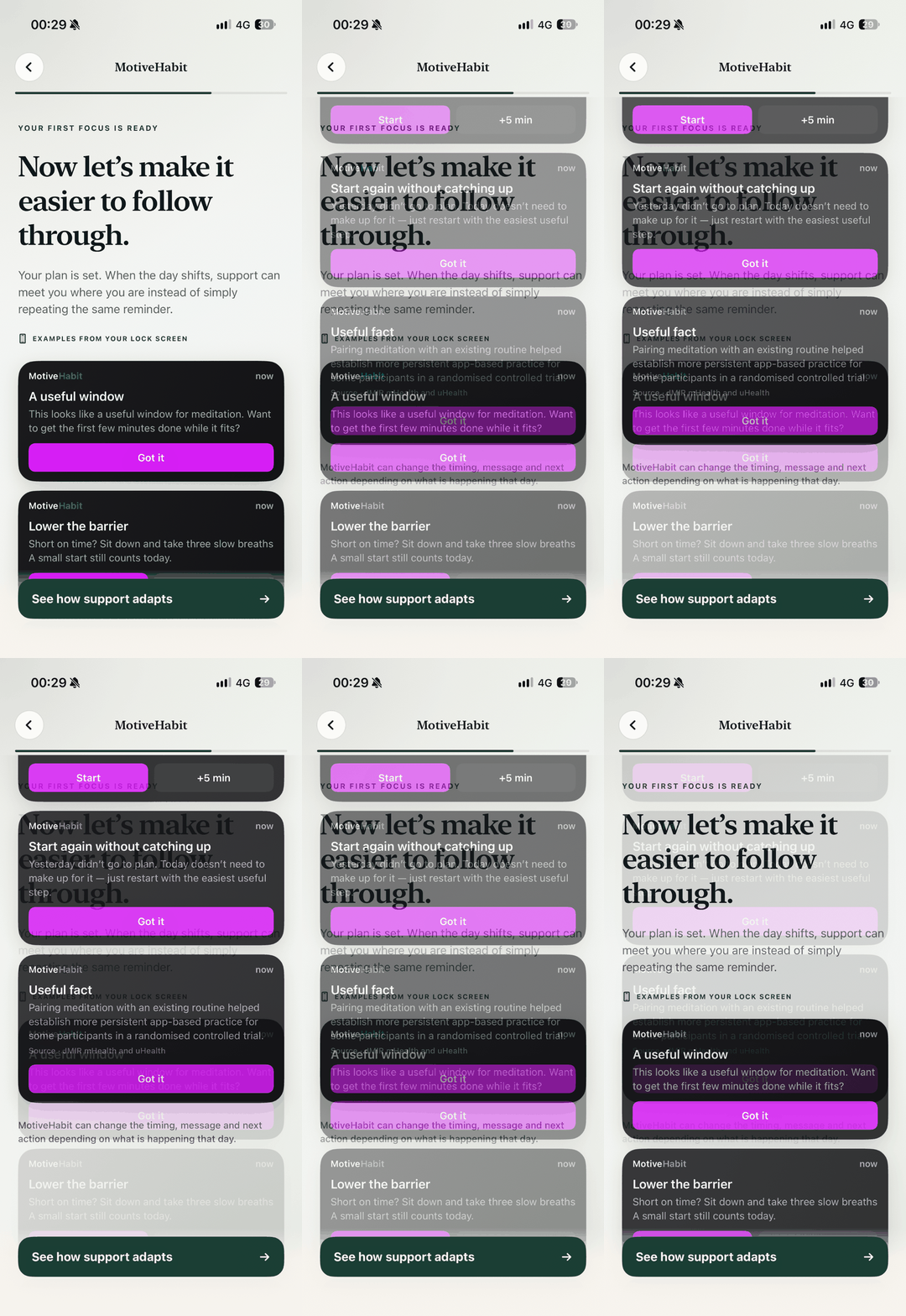 Examples from the MotiveHabit onboarding flow
The reminder should change when the day changes.
MotiveHabit does more than send the same alert at the same time. Its nudges can change with the habit and with what has already happened that day.
Useful windows. Support can move toward the times when you often follow through.
Lower the barrier. When time is short, the next step can become smaller.
Recovery. After a miss or lapse, the next message can help you restart without catching up.
Useful facts. Some support can explain why a strategy may help, instead of only saying “remember your habit.”
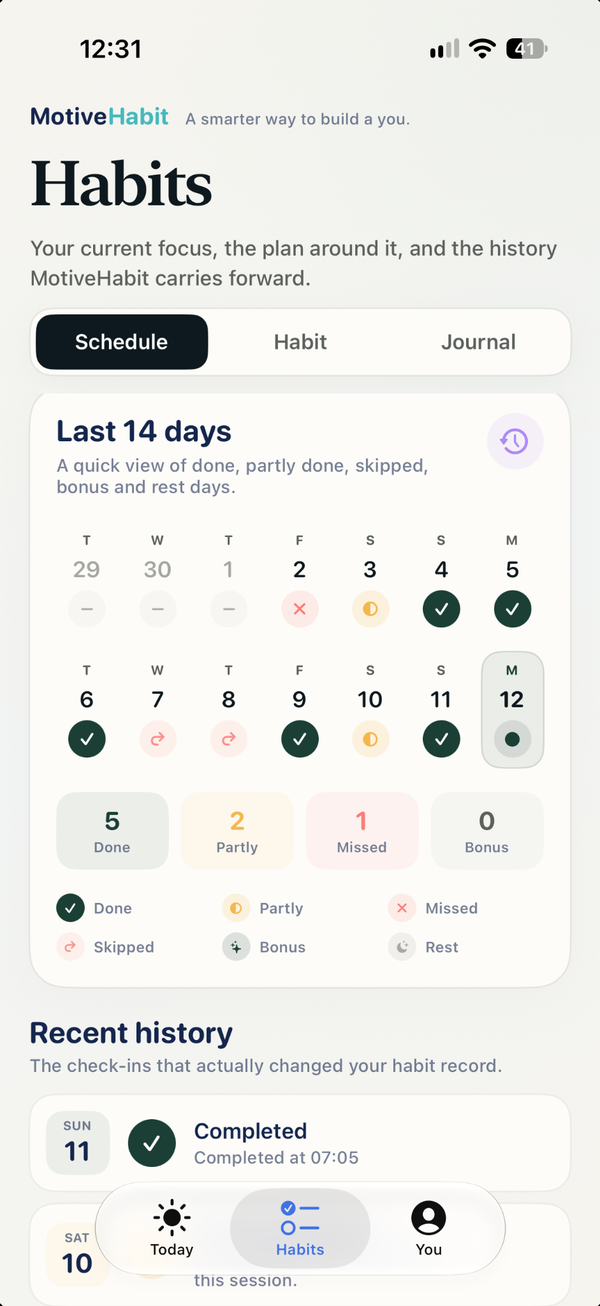
Planned and actual can both be useful.
The Habits tab opens on Schedule. You can see what was planned, what really happened, bonus sessions and recent history without treating every blank day as failure.
You
A living picture of what helps you follow through — built from what you actually do.
How you tend to change
Six parts of how you build habits that MotiveHabit has learned from your check-ins.
Mornings work best
Progress works best
Direct is working
Low energy shows up most
Smaller restarts work best
Mornings keep showing up
You follow through more often in the morning across more than one habit. Your next plan can start there instead of guessing.
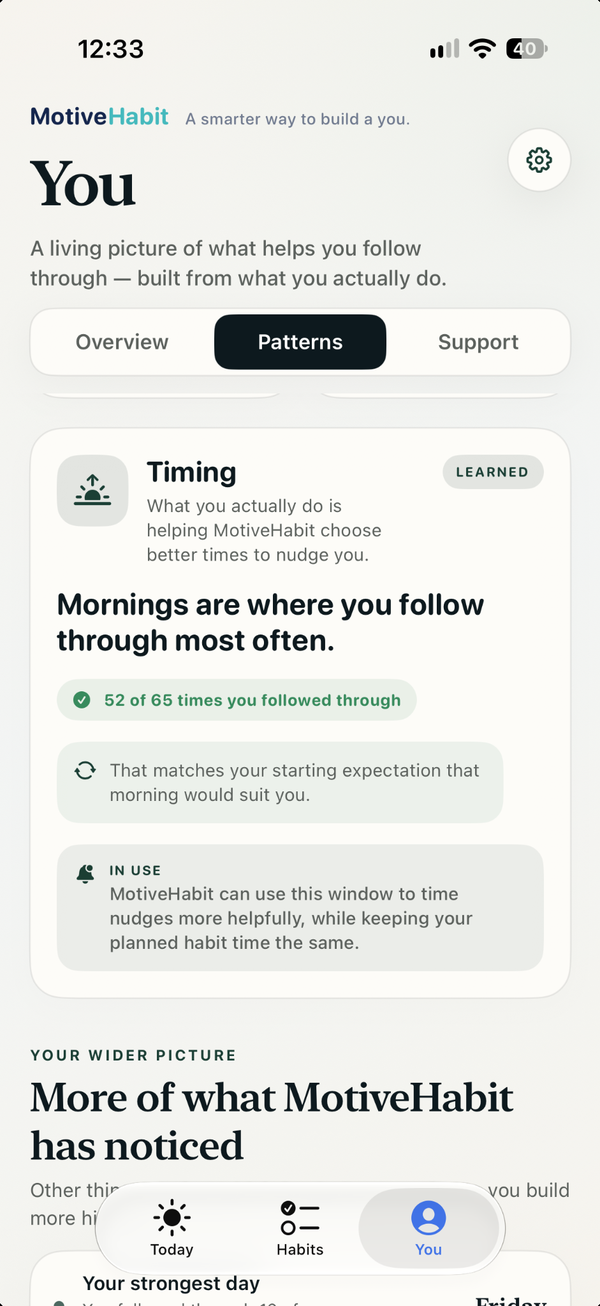
Three months of check-ins should show something useful.
The You tab uses six real areas: Timing, Motivation, Coaching, Friction, Recovery and Across habits.
The overview shows the patterns MotiveHabit has learned. Open a card and you can see the evidence behind that finding and how the app can use it.
When one habit ends, useful learning can stay with you and help shape the next focus.
The habit changes. The support should change with it.
One active focus
Work on one habit at a time, so the app can learn what really helps you.
Actual timing
See the time you planned and the time the habit really happened.
Adaptive nudges
The timing and words can change as MotiveHabit learns what helps you act.
Recovery support
If a day goes wrong, the next prompt helps you restart instead of catch up.
Reflections
Short check-ins show what helped, what got in the way and how the habit felt.
Your profile
Timing, motivation, coaching, friction, recovery and nudge response build into a clearer picture of you.
Schedule, history and maintenance stay together.
Graduated habits stay in your history. Habits you still want to watch can move into lighter maintenance without taking over your one active focus.
Habits
Your current focus, the plan around it, and the history MotiveHabit carries forward.
Choose one thing to work on. MotiveHabit will keep what it has already learned about you.
Choose my next habitMaintenance
Past habits
Build one habit. Learn something useful about yourself.
MotiveHabit is now available on the App Store. Start with one habit and get support that adapts as you learn what works.